CASH NETWORK
Back in 2011 there was a movie called Moneyball, with Brad Pitt playing a baseball executive who throws out a century of conventional wisdom and starts asking a simple question the rest of the room did not want to hear. What if the thing everyone accepts as true just isn't? The whole story turns on looking at the data everyone else ignored and finding value hiding in plain sight.
Healthcare pricing has its own version of that room. For years we have all agreed that the insurance rate is the real rate. It is printed on the statement. It comes from a network. It looks official. So nobody questions it.
Here is the part that sounds backwards. The cash price, the one a provider sets for someone paying directly, is often lower than the rate your insurance company negotiated on your behalf. The insurer is supposed to have the bargaining power. The data says otherwise.
A 2023 study published in Health Affairs looked at 2,379 hospitals and the prices they are now required to disclose for 70 common shoppable services. In roughly half of those hospitals, the cash price came in below the median commercial rate negotiated by insurers. In about one in five, the cash price was at or below the lowest insurance rate the hospital had on file. A separate analysis out of Trinity College found that 60 percent of negotiated rates were higher than the cash rate for the same service.
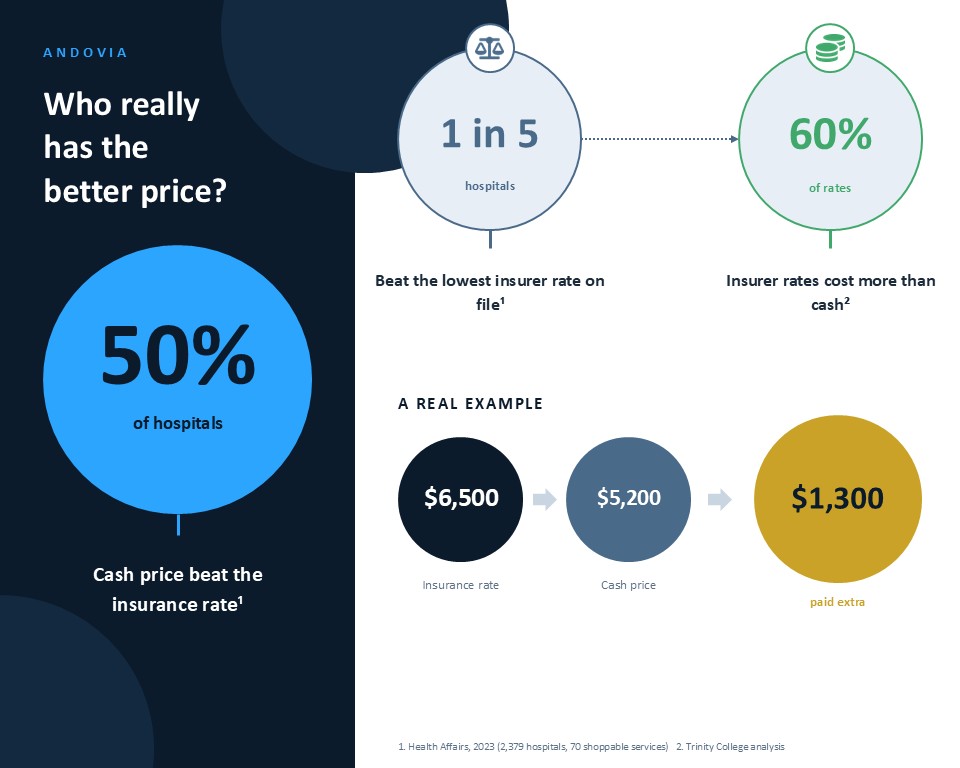
That is the cash network. It is not a loophole, and it is not a trick. It is a provider offering a straight, published price to anyone willing to pay directly, without the insurance machinery sitting in the middle. Same machine. Same physician. Same building. The only thing that changed was who was watching the price.
The math gets problematic up close. Picture an employee with a $6,000 deductible who needs a procedure the plan negotiated at 6,500 dollars. Because they have not met the deductible, they pay the whole thing. If that same hospital posts a cash price of $5,200 for the identical service, the insured patient just paid $1,300 more than someone who walked in with no coverage at all.
Here is the part that should bother every employer. If you are self-insured, that cash price was always available to your plan. The researchers behind the Health Affairs study said it plainly. Some self-insured employers are paying more than the cash price, and they could use those cash rates as a benchmark or contract directly with lower-priced providers. You just never saw it, because the system is built so the party paying the bill is the last one to find out what anything costs.
None of this works without data. You cannot route to a better price you cannot see, and you cannot control spend you cannot measure. Once you can line up the network rate against the cash rate in real time, the cash network stops being a nice idea and becomes a choice you make on purpose. Insight leads to action. Action leads to savings.
We are not asking anyone to blow up their health plan. We are simply asking the same question that ran through that baseball movie fifteen years ago. What if the price you were told to accept was never the best price at all?
Sources:
Wang Y, Meiselbach MK, Cox JS, Anderson GF, Bai G. "The Relationships Among Cash Prices, Negotiated Rates, and Chargemaster Prices for Shoppable Hospital Services." Health Affairs 42, no. 4 (April 2023): 516–525. https://www.healthaffairs.org/doi/10.1377/hlthaff.2022.00977
Ruiz Sánchez, G. "Variation in Reported Hospital Cash Prices Across the United States and How They Compare to Reported Payer-Specific Negotiated Rates." Economics Letters 211 (2022): 110226. https://www.sciencedirect.com/science/article/abs/pii/S0165176521004687